
Bromley could make low-income working-age households pay at least 60% of their council tax from April 2027. Councillors look at the option on 23 November.
Low-income households of working age in Bromley could have to pay at least 60% of their council tax from April 2027, up from 50% now. The change is one of two options in a council report on next year’s Council Tax Support scheme.
It would affect all 7,446 working-age households getting support. Pensioners would not be affected: their support is set by national rules and still covers the whole bill.
The report goes to the Executive, Resources and Contracts scrutiny committee on Monday 23 November (Bromley Council report FSD26072). The portfolio holder for resources then chooses which option goes out to public consultation. Nothing has been decided.
Overview
- Option 1 keeps the current scheme: working-age households pay at least 50% of their bill, and support is capped at the Band D level.
- Option 2 raises the minimum payment to 60% and keeps the Band D cap. The report puts the gain to the council at more than £1.1 million a year.
- Who is affected: 7,446 working-age households, including 1,881 disabled claimants and 2,458 households with children.
- Any change needs a public consultation, and the final scheme must be adopted by full council by 11 March 2027.
The two options
Councils have designed their own support schemes for working-age people since the national scheme ended in 2013. Bromley raised its minimum payment to 50% from April 2025, after a consultation. It also raised its hardship fund to £260,000 a year.
The report sets out the choice for 2027/28:
| Option | Minimum payment | Band D cap | Effect on the council |
|---|---|---|---|
| 1, current scheme | 50% | Yes | No change |
| 2 | 60% | Yes | More than £1.1m a year |
The report’s table prints the second figure in thousands of pounds and cuts it short at “1,14”, so the exact sum is not shown. All the figures use 2026/27 council tax levels.
The report says the council faces “a significant budget gap”. It adds that any change “needs to be balanced against the affordability for low-income households and impact in terms of Council Tax collection”.
What 10 percentage points means in pounds
Bromley’s Band C bill for 2026/27 is £1,902.26, according to the council’s published band charges. Band C is the most common band among working-age claimants.
For a Band C household getting the most support the scheme allows:
- at 50%, the household pays at least £951.13 a year
- at 60%, it would pay at least £1,141.36 a year
That is £190.23 more a year at this year’s rates. For a household on partial support, the change depends on its income.
Who gets support now
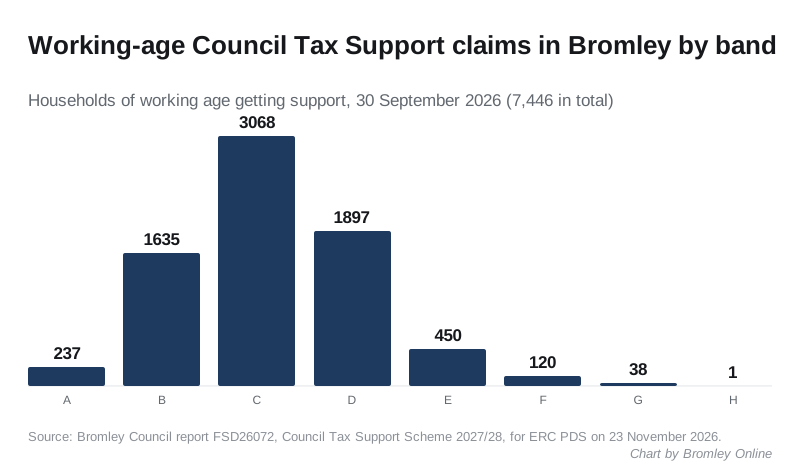
At 30 September, 12,534 Bromley households were getting Council Tax Support. Of those, 7,446 were of working age and 5,088 were pensioners. The working-age claims by band were:
- Band A: 237
- Band B: 1,635
- Band C: 3,068
- Band D: 1,897
- Bands E to H: 609
The 609 households in Bands E to H are also hit by the Band D cap, which limits their support to what a Band D home would get.
The report says the caseload has fallen by 572 since the April 2025 changes, though it has risen by 147 since September 2025.
Collection is already harder
The report shows how much of this year’s bills households getting support had paid by 30 September:
- working-age households: 45.49%
- pensioner households: 70.83%
- all households getting support: 48.30%
The scheme for 2025/26 cost £12.6 million. The report says the collection rate for those households that year was 85.41%, but that figure included £500,000 from the Household Support Fund. The scheme for 2026/27 is expected to cost £13.1 million, of which £5.67 million goes to working-age claimants.
The hardship fund is expected to run out this year, with “applications for assistance outweighing the amount of assistance available”. The report says the fund will be reviewed alongside the final scheme.
What it means for you
- If you get Council Tax Support and are of working age, your minimum bill could rise from April 2027 if Option 2 is chosen. Pensioners are not affected.
- Disability benefits, Child Benefit and child maintenance are not counted as income under the scheme, and allowances are made for childcare costs, the report says.
- If you are struggling now, the report says a discretionary hardship fund covers exceptional circumstances. The council’s Council Tax Support page explains how to claim.
- If a change is proposed, there will be a public consultation open to everyone, whether or not they claim support. The report budgets £8,000 for it.
Have your say