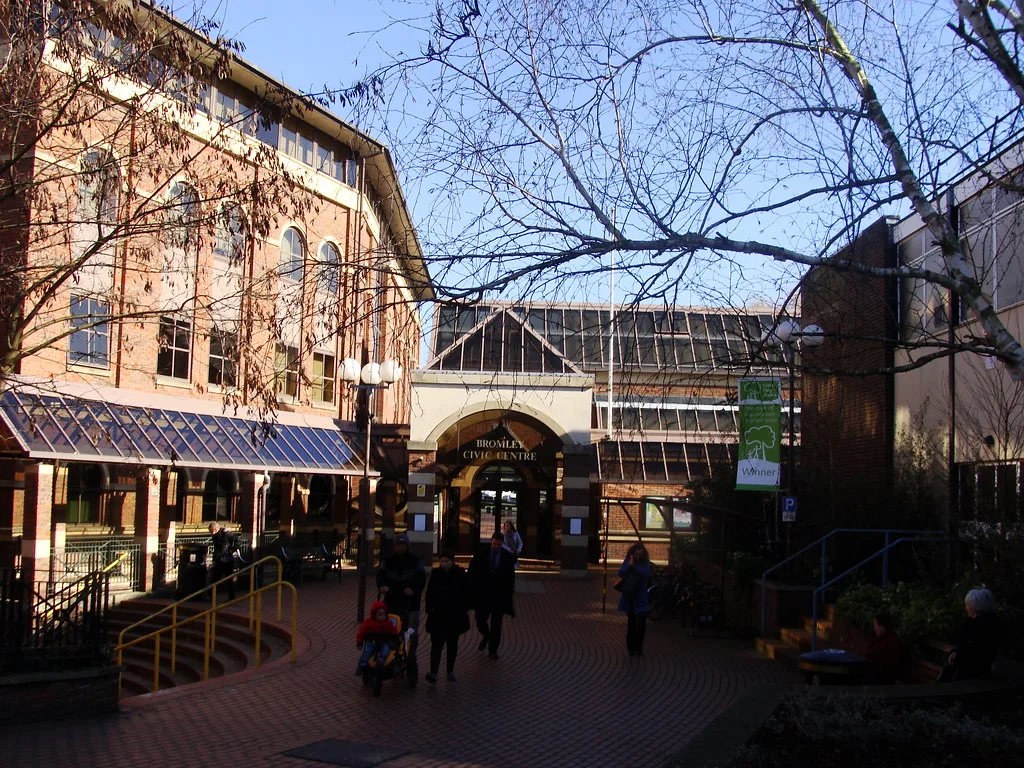

Bromley has no planning portal, it has a Public Register at planningaccess.bromley.gov.uk. Which system to use, how to search it, the 21-day window and the £639 fee.
Every one of the Bromley planning applications lodged in the borough, from a rear extension in Petts Wood to a block of flats in Beckenham, goes on a public register that anyone can search for free, without an account. You get to see the drawings, read the officer’s reports once a decision is made, and put your own comments on the file. Most people only discover a scheme exists when the scaffolding goes up next door. This is where the register lives, how long you have to comment, and, just as importantly, which arguments the council is legally allowed to listen to.
Where to search Bromley planning applications
Bromley runs its own Public Register, and it is not the Idox Public Access system that most Kent and London councils use. The register is reached from the council’s search planning applications page, which links through to:
- planningaccess.bromley.gov.uk for the Public Register itself.
One warning worth having. A few of the council’s older pages still point at an address beginning searchapplications.bromley.gov.uk, which did not respond when we checked it. If you land on a dead link, go back to the planningaccess page and follow the Public Register link from there.
The register lets you follow the progress of an application, open the documents and plans, submit a comment, look at a weekly list of applications and decisions, view historic applications and property details, and search enforcement notices.
The Bromley planning portal: two different things with the same name
Search for a Bromley planning portal and you will be sent to two completely different systems, which is why so many people end up on the wrong one.
- The council’s Public Register, at planningaccess.bromley.gov.uk, is where Bromley’s own applications live. This is the one you want if you are looking up a neighbour’s extension, reading an officer’s report, checking a decision or leaving a comment. It runs on Arcus rather than the Idox Public Access software used by most surrounding boroughs, so if you have used another council’s site the layout and the search boxes will not match.
- The national Planning Portal, at planningportal.co.uk, is the government-backed service for submitting an application anywhere in England and Wales, and for its general guidance on what needs permission. It holds no Bromley records and you cannot search the borough’s applications on it. If you are the applicant or the agent, this is where the form and the fee go; if you are a neighbour, it has nothing for you.
The short version: to look something up, use the Public Register. To apply for something, use the Planning Portal. The council’s search planning applications page is the safe starting point either way, because it always links to the current register address.
What the Planning Portal costs if you are the one applying
The half of the split most pages leave out: if you are the applicant rather than the neighbour, the national Planning Portal is where the money goes, and there are two separate charges on the same submission.
- The statutory planning fee, set by government and passed to Bromley. A standard householder application in England is £548. English fees rose by 3.8 per cent on 1 April 2026, so any figure quoted from before that date is low (Planning Portal).
- The Planning Portal’s own service charge, which is £75.83 plus VAT, so £91.00 in practice. It is charged on any application attracting a fee of over £100, and it is kept by the Portal rather than the council.
A householder application submitted online therefore comes to about £639 before anything is spent on drawings. That charge is unavoidable through the Portal itself, and it is a separate line from the council’s own £100 compliance check fee covered further down, which buys a different thing: a view on whether work already done complies, not permission to do it.
Getting your search right
Bromley’s register is fussier about references than most, and the council spells out the traps:
- Include the suffix. Search
25/00001/FULL5, not25/00001. Bromley’s suffixes are longer than the usual Idox ones. - Do not add a
DC/prefix. It will not match. - Use the full address, not a fragment. Only key words of an address are matched, so a partial entry broadens rather than narrows the result. The council’s own example is “Example first line, Orpington, BR1 1DU”.
- Remember addresses are frozen in time. Applications are recorded against the address as it was when they were submitted, so a property that has since been renumbered or renamed will not show its full history under its current address.
- Use Advanced Search for anything vague. You can filter by category, description of works, site address, application type and date range.
If you would rather work from a map than a search box, the council also publishes a Public Register map which shows planning and building control applications geographically. It is also the quickest way to find out which ward an address falls in, which matters for the next step.
Set up email alerts by ward
The single best habit if you want to keep an eye on your area is to use the register’s Subscribe for Notifications feature. It emails you about planning decisions, applications due to be decided at committee, and newly valid applications, filtered by ward. Set it once and the council’s own system watches the street for you, rather than you remembering to run the same search every Friday.
How you find out, and how long you get
Before deciding an application, Bromley usually writes to the neighbours immediately adjoining the site. Some applications are publicised more widely, by site notice or by an advert in the News Shopper, and the council lists exactly which ones get that treatment: those affecting a listed building or a conservation area, those departing from the local development plan, and those affecting a public right of way (viewing and commenting on planning applications).
You normally get 21 days to comment. Two things about that window are worth knowing.
First, the council will normally accept representations right up to the day of the decision, even after the 21 days has run out. If a committee report has already been published, late comments are usually summarised verbally at the meeting instead. What cannot be considered is anything arriving after the decision has been made, even if you posted it beforehand.
Second, and this catches people out, Bromley does not tell you when a decision is expected. The council says openly that resource pressures mean it does not notify applicants, agents or neighbours of expected decision dates. If you want to know when your case is likely to land, you have to check the register yourself or ring the planning team.
How to comment, and what actually counts
You can comment in two ways. The straightforward route is through the register: open the application and select Submit comments at the top of the page. If you live in the borough you will be asked for your address. The alternative is to write to Planning, Civic Centre, Stockwell Close, BR1 3UH, quoting the planning reference.
Give your address either way. The council states that objections without an address cannot normally be given any weight in the decision, which makes an anonymous objection close to worthless. Your comment will also be published: legally the council must let the public see representations, so they go on the website with signatures, email addresses and phone numbers redacted, but they cannot be treated as confidential.
Now the part that decides whether your objection does anything. A planning decision can only turn on material planning considerations. Bromley names impact on lighting and highway safety as its own examples of what counts, and publishes a blunt list of what does not.
| The point you want to make | Does it carry weight? |
|---|---|
| It will block the light to my rooms | Yes. Impact on lighting is one of the council's stated examples |
| The access is dangerous for traffic | Yes. Highway safety is the council's other stated example |
| It will reduce the value of my property | No |
| It competes with an existing business | No |
| I will lose my view | No |
| The building work will be disruptive | No |
| There is a dispute over who owns the land | No |
| It breaches a private deed or covenant | No |
| They have already started building | No |
| It is a licensing or gambling concern | No, that is covered by other legislation |
What it means for you: the same worry can be a strong point or a wasted one depending on how you frame it. “This will devalue my house” is inadmissible; “this will overshadow my kitchen window and remove daylight from a habitable room” is the same concern expressed as a material consideration, and it has to be weighed. One clear, planning-grounded objection generally does more than fifty copy-pasted ones.
Who decides, and when it goes to a committee
Bromley aims to determine 90 per cent of applications under delegated powers, meaning the decision is taken by officers under the Assistant Director for Planning and Building Control rather than by councillors. The remainder go to a committee, where elected members vote in public (determination of planning applications).
The relevant bodies are the Development Control Committee and two Plans Sub-Committees, numbered 1 and 2. Agendas are published on the council’s democratic services site five working days before each meeting, and if you want to know whether a particular application went to committee, the register’s important dates tab gives you the meeting date to look up.
Decisions are made in line with the development plan unless there is a very good reason to depart from it. In Bromley the development plan is the Bromley Local Plan, adopted on 16 January 2019, together with the London Plan. The Local Plan is currently under review, with a Call for Sites in 2021, an Issues and Options consultation in 2023 and a second Direction of Travel consultation between July and September 2025 (review of the Bromley Local Plan); our Bromley planning news page tracks the new plan’s timetable and housing numbers. You can see which designations apply to any site on the interactive Local Plan map.
If an application is refused, the applicant can appeal to the Planning Inspectorate. Objectors cannot appeal a grant of permission, and comments on an appeal go direct to the Inspectorate rather than to the council.
What changes for Bromley on 31 October 2026
The balance between officers and councillors is about to be set nationally rather than locally.
The Town and Country Planning (Discharge of Local Planning Authority Functions) (England) Regulations 2026, SI 2026 No. 854, were made on 15 July 2026 and come into force on 31 October 2026. They apply to every English planning authority, London boroughs included.
- Schedule 1 applications must be decided by an officer, with no route to a committee at all. That list covers householder applications, minor commercial schemes, minor residential of 1 to 9 dwellings on a site under 0.5 hectares, discharge of conditions, non-material amendments, prior approvals, permission in principle and certificates of lawfulness. Most of what an ordinary Bromley resident objects to sits in that list.
- Schedule 2 is everything else and is presumed delegated too. Referring one to the Development Control Committee or a Plans Sub-Committee needs a regulation 5(3) criterion and the agreement of both the council’s nominated officer and its nominated member; if they disagree, the officer decides.
- Regulation 7 caps a planning committee at 13 members.
The statutory guidance issued on 1 June 2026 rules out two practices by name, ward councillor call-in and triggers based on how many objections an application receives, and warns that decisions made under them are liable to judicial review.
What it means for you. Bromley already decides about 90 per cent of applications at officer level. From the end of October the small stuff is fixed there by law, so for a neighbour’s extension or a one to nine home scheme the only lever you have is the quality of the comment you put on the register inside the consultation period. There is no escalation to ask for. That makes the material considerations section above the whole game rather than a first step.
Separately, the Town and Country Planning (Consultation) (England) Direction 2026, made on 31 March 2026, means any scheme of 150 or more homes undetermined at 11 May 2026 cannot be refused without the council consulting the Secretary of State first and then waiting at least 21 days.
If work is going on without permission
Suspected breaches go to the council’s planning enforcement team, which investigates unauthorised building work and changes of use, non-compliance with approved plans or conditions, damage to listed buildings and conservation areas, unlawful adverts and untidy sites. It does not deal with noise or smells on their own, construction methods, private access rights, boundary disputes, or restrictions imposed by covenant (planning enforcement).
If you are the one building and want certainty that what you have done complies, the council runs a compliance check service for a fee of £100.
Frequently asked questions
How do I search planning applications in Bromley?
Use the council’s Public Register, reached from the planningaccess page. No account is needed to look. Search by full address, or by reference including the suffix, for example 25/00001/FULL5.
What is Bromley’s planning portal called?
The council’s own system is the Public Register at planningaccess.bromley.gov.uk. It is not the Idox Public Access software used by most neighbouring councils, so searches behave slightly differently. The separate Planning Portal at planningportal.co.uk is the national service used to submit an application, not to search Bromley’s records.
How long do I have to comment on a Bromley planning application?
Normally 21 days from the start of the consultation. Bromley will usually still accept comments up to the day the decision is made, and comments arriving after a committee report is published are summarised verbally at the meeting. Nothing received after the decision can be considered.
What can I object to in a Bromley planning application?
Only material planning considerations, such as the effect on daylight and highway safety. The council specifically excludes loss of property value, commercial competition, loss of a view, disturbance during building work, land ownership disputes, private covenants, and matters covered by other legislation such as licensing.
Are comments on Bromley planning applications made public?
Yes. The council is legally required to let the public see representations, so comments appear on the website with signatures, email addresses and phone numbers removed. Comments cannot be treated as confidential, and objections submitted without an address are not normally given any weight.
Will Bromley’s planning committees still hear objections after October 2026?
Only on the larger applications. From 31 October 2026 the national scheme of delegation in SI 2026/854 requires householder work, minor commercial schemes and residential of one to nine homes on sites under half a hectare to be decided by an officer, and the accompanying guidance rules out sending an application to committee because of the number of objections or because a ward councillor asked. Your comments still have to be taken into account by whoever decides; the difference is that they can no longer move the decision into the committee room.
How much does a Bromley planning application cost?
The fee is national, not local. A householder application in England is £548, and the Planning Portal adds its own service charge of £75.83 plus VAT, £91.00 including it, on any application with a fee over £100. That is roughly £639 for a typical extension. English planning fees went up 3.8 per cent on 1 April 2026. Bromley separately charges £100 for a compliance check on work already carried out.
Who decides planning applications in Bromley?
Officers decide roughly 90 per cent under delegated powers. The rest go to the Development Control Committee or one of the two Plans Sub-Committees, where councillors vote in public. Agendas appear five working days beforehand on the council’s democratic services site.
Sources
-
Planning Portal, how much does a planning application cost, for the £548 householder fee and the £75.83 plus VAT service charge, checked 31 August 2026
-
legislation.gov.uk, The Town and Country Planning (Discharge of Local Planning Authority Functions) (England) Regulations 2026 (SI 2026 No. 854, in force 31 October 2026)
- GOV.UK, The Town and Country Planning (Consultation) (England) Direction 2026
- London Borough of Bromley, search planning applications, for the Public Register link, the reference format, address searching and notification subscriptions
- London Borough of Bromley, viewing and commenting on planning applications, for the 21 day period, publicity rules, the postal address and the list of non-material considerations
- London Borough of Bromley, determination of planning applications and the committee structure
- London Borough of Bromley, the Bromley Local Plan, its review and planning enforcement
Checked against the council’s planning pages on 4 August 2026. Deadlines and application statuses change, so confirm on the Public Register before relying on a date. Our other guides cover Bromley planning news, Bromley council tax bands, parking in Bromley and Bromley bin collection days.
Have your say