
Bromley's claimant count rose to 7,295 in August, up 135 in a year. Under-25s are up 8.7 per cent and over-50s 4 per cent, while the 25 to 49 group fell.
Bromley’s claimant count stood at 7,295 in August 2026, 3.5 per cent of residents aged 16 to 64. That is 135 more than in August last year. The figures were published by the Office for National Statistics on 15 September (nomis, claimant count by sex and age).
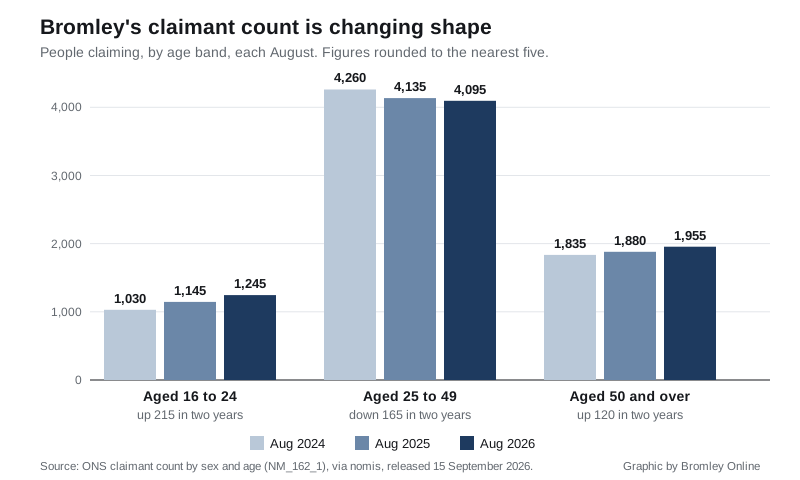
A 1.9 per cent rise over a year is not dramatic. What is happening underneath it is more interesting. Compare August 2026 with August two years ago and the borough’s claimant count has barely grown in total, but its shape has changed:
- aged 16 to 24: 1,030 to 1,245, up 215, a rise of 20.9 per cent
- aged 25 to 49: 4,260 to 4,095, down 165, a fall of 3.9 per cent
- aged 50 and over: 1,835 to 1,955, up 120, a rise of 6.5 per cent
The middle of the working-age range is shrinking. Both ends are growing. Young people now make up 17.1 per cent of everyone claiming in the borough, against 14.4 per cent two years ago.
The year-on-year picture
Over the last twelve months the same split holds, in smaller numbers:
| Age band | Aug 2025 | Aug 2026 | Change |
|---|---|---|---|
| 16 to 24 | 1,145 | 1,245 | +100 (+8.7%) |
| 25 to 49 | 4,135 | 4,095 | -40 (-1.0%) |
| 50 and over | 1,880 | 1,955 | +75 (+4.0%) |
| All aged 16+ | 7,160 | 7,295 | +135 (+1.9%) |
Among the 1,955 claimants aged 50 and over, 155 are aged 65 or above.
By sex, 3,900 of August’s claimants were men and 3,400 were women. Those two do not quite add to 7,295 because nomis rounds every figure to the nearest five.
How Bromley compares with the rest of London
At 3.5 per cent of 16 to 64-year-olds, Bromley has one of the lowest claimant rates in the capital. Only five of the other 32 London boroughs are lower: Richmond upon Thames (2.6 per cent), Kingston upon Thames (3.2), Bexley and Kensington and Chelsea (both 3.4) and the City of London (1.1). Sutton is level with Bromley at 3.5.
London as a whole is on 5.5 per cent and the United Kingdom on 3.9 per cent (nomis, all London boroughs).
The under-25 rise is the exception. Bromley’s 8.7 per cent increase over the year is one of the steepest in London. Leaving aside the City of London, where the whole young claimant count is 25 people, only three boroughs rose faster:
- Hillingdon, up 12.8 per cent
- Greenwich, up 11.6 per cent
- Enfield, up 8.9 per cent
Redbridge is level with Bromley at 8.7 per cent. Five boroughs saw the number of young claimants fall: Westminster, Islington, Hammersmith and Fulham, Newham and Lewisham.
What the number is, and what it is not
This is not the unemployment rate. The ONS is explicit about it. The claimant count “does not attempt to measure unemployment, which is a concept defined by the International Labour Organisation (ILO) as all those who are out of work, actively seeking work and available to start work”. It is instead “a measure of the number of people claiming benefits principally for the reason of being unemployed, based on administrative data from the benefits system” (ONS, Claimant Count QMI).
Since Universal Credit, that includes people who are working but on low earnings and still required to look for more. A rise can mean fewer jobs. It can also mean more people caught by a conditionality rule.
The figures are also revised. When July’s count was first published it stood at 7,320, and that is the number we reported at the time. Nomis now records 7,215 for the same month. The ONS says the Universal Credit part of the count “allows for revisions to the data for one previous month”, so the most recent figure in any release is the one most likely to move.
What it means for you
- If you are under 25 and out of work in the borough, you are part of a group that has grown by more than a fifth in two years. The council’s employment and careers page is the local starting point; it lists careers advice for young people, local learning shops, the National Careers Service and Jobcentre Plus.
- If you are over 50, the count has risen four per cent in a year. That band is now bigger than the under-25 band by 710 people.
- The next release, covering September 2026, is due on 20 October.
- Our earlier piece on the same series, Bromley’s under-25 claimant count, covers the two-year trend in more detail. The other monthly release out this week went the other way: Bromley house prices fell £16,284 in a year.
Sources
- ONS claimant count by sex and age, via nomis, dataset NM_162_1, Bromley E09000006, released 15 September 2026
- ONS Claimant Count Quality and Methodology Information
Have your say