
Concerns that a Bromley adult was being abused or neglected rose 46% to 3,813 in 2025/26. Formal enquiries rose 60% to 552, the safeguarding board says.
Concerns that an adult in Bromley was being abused or neglected rose by 46% last year, to 3,813. The figure is in the Bromley Safeguarding Adults Board’s annual report for 2025/26, which goes to the council’s Adult Care and Health scrutiny committee on Tuesday 17 November.
The number that became formal enquiries rose faster still. There were 552, up 60% from 345 the year before. A formal enquiry is the legal duty under Section 42 of the Care Act 2014 to look into whether an adult with care and support needs is being abused or neglected, and what should be done.
The board brings together the council, the NHS, the police and other partners. Its annual report puts the rise down to “growing demand and increased identification of risk across the partnership”.
Overview
- 3,813 safeguarding concerns were raised in 2025/26, up from 2,607 (46%).
- 552 became formal enquiries, up from 345 (60%).
- 559 enquiries concluded, up from 376 (49%).
- 28,562 calls reached the council’s adult social care service, up from 18,330.
- Neglect and physical abuse were the most common risks. 42% of cases happened in the person’s own home.
The year in numbers
The report’s figures come from the council’s adult social care records (BSAB annual report, section 5).
| Measure | 2024/25 | 2025/26 | Change |
|---|---|---|---|
| Calls to adult social care | 18,330 | 28,562 | +56% |
| New referrals to adult social care | 4,117 | 3,868 | -6% |
| Safeguarding concerns | 2,607 | 3,813 | +46% |
| Concerns that became enquiries | 345 | 552 | +60% |
| Enquiries concluded | 376 | 559 | +49% |
Of the 559 enquiries concluded, 520 were formal Section 42 enquiries. The rest were recorded as “other”.
New referrals for care fell slightly while calls jumped by more than half. The report does not explain that gap.
What kind of harm
Neglect and acts of omission were the most common risk, in 21% of the concluded enquiries. Physical abuse came next at 20%, then psychological abuse at 15%.
Self-neglect rose from 8% of enquiries in 2024/25 to 14%. Organisational abuse, where the harm comes from how a care service is run, tripled as a share, from 2% to 6%.
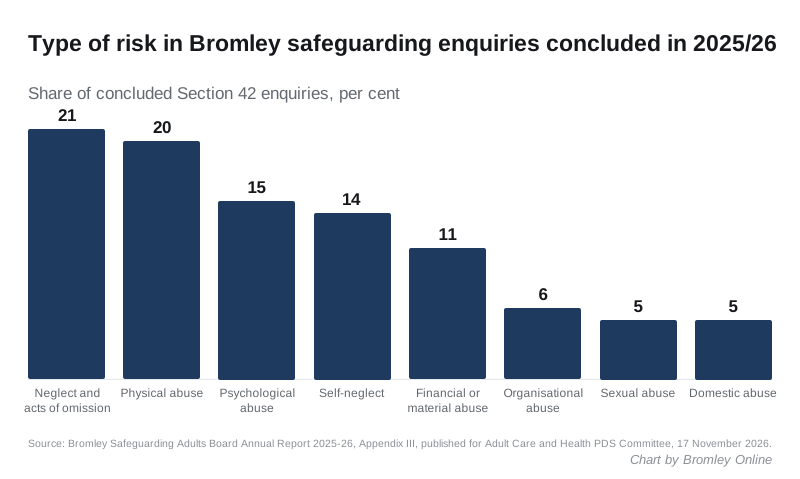
Financial or material abuse fell as a share, from 15% to 11%. The board says partners have worked with Trading Standards and banks on scams, fraud and economic abuse.
Where it happened and who was affected
The figures for concluded Section 42 enquiries in 2025/26 show:
- Own home: 42%, up from 38%
- Mental health hospital: 29%, up from 27%
- Residential care home: 10%, up from 6%
- Acute hospital: 6%, up from 3%
- Nursing home: 3%, down from 4%
In 95% of cases the risk came from someone known to the person. A service provider was the source in 2%, and a stranger in 3%.
Women were the subject of 58% of enquiries, up from 53%. Just over half, 53%, involved adults aged 18 to 64.
What else the report says
- Referrals to independent domestic violence advisers from adult social care rose from 13 to 35.
- By March 2026, 31 of Bromley’s 43 GP practices had finished IRIS training, which helps surgeries spot and refer domestic abuse.
- Bromley Well, the voluntary sector service, received 18,593 referrals, up 10.4%, and supported 13,039 residents.
In the year the board completed one Safeguarding Adults Review and a multi-agency learning review, and started a further review. It also lists “increasing demand, workforce pressures, health inequalities” among the challenges ahead.
The committee is asked to note the report. It meets at 7pm on Tuesday 17 November (meeting papers).
What it means for you
If you are worried that an adult is being abused or neglected, the council’s safeguarding page gives these routes:
- In an emergency: dial 999. If the abuse is a crime, the council says you should also contact the police.
- During office hours: call the council on 020 8461 7777, or report it online.
- Out of hours (5pm to 8.30am and weekends): call 0300 303 8671.
- A care home or home care agency: report it the same way. You can also tell the Care Quality Commission.
The council says what happens next depends on how serious the situation is and what the person wants to do about it.
Have your say