
Three more upheld Ombudsman findings on Bromley EHC plans: a transfer left five months, a placement never found, a review eight months late. £1,000 to be paid.
Bromley Council has been found at fault in three more Education, Health and Care plan cases. The Local Government and Social Care Ombudsman decided all three between 29 July and 4 August, and the decisions are now on its public register. The council has agreed to apologise and to pay £1,000 in total across the three families.
None of the three is the June case we reported last month, in which the council agreed to pay £11,660 after a young person went 20 months without the support his plan promised (our report, 26 August). These are new findings, and they share a theme: paperwork that did not move.
The three decisions are:
- A five-month delay in processing a child’s plan after the family moved into the borough. Payment £200 (decision 25 012 808, 30 July 2026).
- A placement that was never found after a school said it could not meet a child’s needs, with the council admitting it had lost oversight of the case. Payment £500, the Ombudsman’s maximum for distress (decision 25 016 169, 4 August 2026).
- An annual review issued almost six months late and almost eight months after the deadline for a move into post-16 education, while the child was on eight hours of education a week. Payment £300 (decision 25 012 498, 29 July 2026).
The Ombudsman does not name the families or the schools, and neither do we.
The five-month transfer
When a child with an EHC plan moves between council areas, the new council must make sure the provision in the plan starts on the day of the move, or within 15 working days of learning about it if that is later. The Ombudsman sets that out in decision 25 012 808.
In this case the child, called Y in the decision, had a plan first issued by another council in September 2019. The family moved into Bromley in March 2024. The old council told Bromley about the move at the end of May 2024, so Bromley should have had Y’s provision in place by the third week of June.
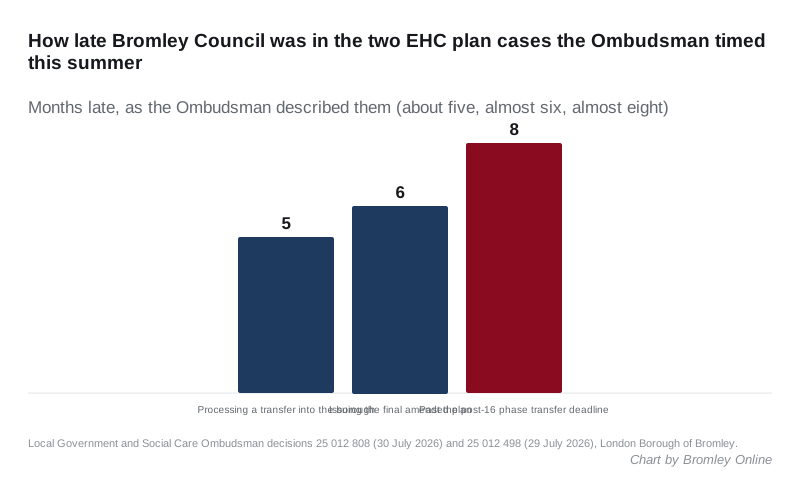
Bromley did not process the move until the second week of October 2024. It issued Y’s plan in November 2024. The Ombudsman called that “a delay of approximately 5 months” and found it caused “distress, frustration and uncertainty”.
The father had also asked for his travel costs back. He applied for home-to-school transport in March 2025. The council confirmed Y was eligible the next day and the transport started the following week. In June 2025 he asked the council to reimburse the cost of getting Y to school between May 2024 and March 2025. The council refused, and held that line through both stages of its appeal process, because he had not applied before March 2025.
The Ombudsman found no fault in that refusal. The council “took account of the relevant guidance, information from Mr X and its own policies”, and the investigator wrote that it could not therefore be criticised. The finding against the council is the transfer delay alone. Within a month of the decision the council must apologise and pay £200.
The placement that never came
The second case is the one the Ombudsman describes most bluntly. A child, B, was at a mainstream school with an EHC plan. At a review in February 2024 the school and the mother both asked the council to find a different placement. The council agreed and began consulting other schools.
The mother complained to the council in July 2025. The council replied in October 2025 and upheld her complaint. In its own words, as recorded in decision 25 016 169, it:
- had not had proper oversight of B’s case
- had failed to secure an alternative placement
- had communicated poorly, with staffing changes meaning B’s caseworker “had not stayed consistent”
The council apologised at that point. The Ombudsman decided an apology was not enough. “I am not satisfied that the apology alone remedies the scale of the injustice,” the investigator wrote, and set the payment at £500, the maximum in the Ombudsman’s remedies guidance for uncertainty, distress and frustration. The council has four weeks from 4 August to pay it.
One detail matters for other families. The mother told the Ombudsman her child had been out of school for three years. The Ombudsman only looked at October 2024 to October 2025, because she had not complained within 12 months of the earlier events and the investigator found no good reason to go further back.
The review that ran eight months late
The third case, decision 25 012 498, concerns a child, Y, whom the council had placed at a specialist school in September 2022. Y was on a reduced timetable from 2023. Before the 2024-25 school year the school told the council it could no longer meet Y’s needs and set out what it would offer instead:
- four hours a week of one-to-one home tuition in maths and English, on Tuesdays and Thursdays
- four hours a week on a motorbike mechanics course with another provider, on Mondays and Fridays
- work experience on Wednesdays
The Ombudsman notes that full-time education “is commonly held to be equivalent to between 22 and 25 hours a week”, and that it was clear from what the school sent that this package “would not be full time”. The council should have decided whether that was suitable and kept it under review. It could not produce any record of having done so. The Ombudsman found, on the balance of probabilities, that it had not.
The review timetable is the starker failure. The council held Y’s annual review meeting at the end of February 2025. Y was moving into post-16 education that September, so the amended plan was due by the legal deadline of 31 March 2025, and in any event by mid-May. The council issued it in November 2025. The Ombudsman counted that as “almost six months outside statutory timescales and almost eight months after the phase transfer deadline”. The council’s explanation was that the case officer had been absent through illness.
The council was not at fault on one count. Y’s plan entitled him to therapeutic intervention, pastoral support, social skills work and language assessments, and the council showed it had provided them. It must apologise and pay £300 within a month.
The pattern the Ombudsman has already noticed
Twice in the third decision the investigator writes the same sentence: “We found fault with the Council on a similar case.” After the earlier cases Bromley agreed to draw up an action plan on annual review delays, and to introduce a decision checklist so that officers record what they decided about a child out of school and why. The Ombudsman says it will monitor both “through our case work”, which is why it asked for no new service improvements this time.
The wider numbers are in our August report. In the year to 31 March 2026 the Ombudsman upheld 49 of the 54 Bromley complaints it investigated, a rate of 91 per cent. In only one of those 49 had the council already put things right before the complaint reached the Ombudsman (Ombudsman statistics for Bromley).
The department has a new permanent head. Andrew Carter was appointed Director of Children, Education and Families on 16 September (our report). The council’s SEND Local Offer moved to a new website, bromleysend.org, at the start of the month (our report).
What it means for you
If you move into Bromley with a child who has an EHC plan, the council must have the plan’s provision running within 15 working days of being told about the move, if it was not already in place on the day you arrived. Keep the date your old council notified Bromley. In the first case above, that date was what the Ombudsman measured the delay from.
If your child’s plan is due an annual review, the sequence and the deadlines are fixed in law. The review meeting must happen within 12 months of the last one. The council must tell you within four weeks of the meeting whether it will amend the plan. If it amends, the final plan is due within eight weeks of that notice. For a move into post-16 education, the amended plan naming the new place must be issued by 31 March of the year of the move.
If your child is out of school, the council has a separate duty under section 19 of the Education Act 1996 to arrange suitable education. The Ombudsman’s guidance says it should make a written, evidence-based decision on that and tell you what it decided. Ask for that decision in writing. In the third case the council’s failure was that it could show no record of having made one.
Do not wait to complain. Two of the three families lost part of their case to the 12-month rule: the Ombudsman will not normally look at anything that happened more than a year before you complain to it. Complain to the council first, through its complaints procedure. If you are not satisfied with the final response, complain to the Ombudsman, and do it within 12 months of the events.
The council’s own pages on requesting an assessment, what goes into a plan and annual reviews are at bromley.gov.uk. Independent advice is available from the borough’s SEND information, advice and support service, listed on the Local Offer.
Sources
- Local Government and Social Care Ombudsman, decision 25 012 808, London Borough of Bromley, upheld, 30 July 2026 (the March 2024 move, the end-of-May notification, the October 2024 processing, the November 2024 plan, the £200 payment, no fault on transport or reimbursement)
- Ombudsman decision 25 016 169, London Borough of Bromley, upheld, 4 August 2026 (the February 2024 review, the council’s October 2025 complaint response, the £500 payment, the 12-month rule)
- Ombudsman decision 25 012 498, London Borough of Bromley, upheld, 29 July 2026 (the 2024-25 package of eight hours a week, the 31 March 2025 deadline, the November 2025 plan, the £300 payment, the earlier action plan and checklist)
- Ombudsman: London Borough of Bromley statistics, 1 April 2025 to 31 March 2026
- Ombudsman: decisions for the London Borough of Bromley, 1 July to 25 September 2026
Have your say