
A young person in Bromley went 20 months without the support his EHC plan promised. The council fixes just 2% of upheld cases early, against 14% elsewhere.
Bromley Council has agreed to pay £11,660 to the mother of a young person who went 20 months without the support his Education, Health and Care plan promised. The Local Government and Social Care Ombudsman upheld her complaint on 24 June (decision 24 023 431).
The council did not dispute it. In its response to the Ombudsman’s enquiries it accepted:
- that “Mr Y” had missed provision from January 2024 to August 2025
- that its record keeping was inadequate
- that its communication “fell short of standards families should expect”
- that its annual review of his plan was unreasonably delayed
The Ombudsman anonymises everyone in its decisions. The complaint was brought by the young person’s mother, “Miss X”.
What the decision found
The council issued Mr Y’s final EHC plan in September 2023. He was not attending a setting from late that year, so he was not receiving the provision the plan set out.
The law makes that the council’s problem. The duty to secure the provision in section F of a plan sits with the council personally. The courts have held it cannot be delegated away to a school or anyone else.
The Ombudsman upheld the complaint on four counts.
- Missed provision. The council failed to ensure Mr Y received the education and provision in his plan for 20 months.
- No annual review. The law requires a review at least every 12 months. The council did not review the plan at all in 2024. Miss X asked for an urgent review in August 2024; the review happened in May 2025, and the updated final plan was not issued until September 2025.
- Communication. The council accepted this fell short of what families should expect.
- Complaint handling. The council told the Ombudsman it could not find evidence of a complaint from January 2025. The investigator found it, titled “complaint regarding failure to provide adequate academic and mental health support”, and found the council had replied to that document agreeing to review the plan while never responding to the complaint itself.
The payment breaks down into three parts:
- £9,000 for missed education, at £450 for each of the 20 months
- £2,160 for 36 sessions of missed therapeutic provision
- £500 for the distress, frustration and uncertainty caused to Miss X
The first two, £11,160 together, are to be used for Mr Y’s benefit.
The council was also told to apologise to both of them and to give its officers guidance on accurate record keeping, all within four weeks of the decision. Under an information-sharing agreement, the Ombudsman sends decisions like this one to Ofsted.
It is not the only one
This was not an isolated finding. Two of the ten Bromley decisions the Ombudsman has listed since 1 June 2026 were upheld, and both concerned special educational needs. The other eight were closed after initial enquiries without a full investigation.
The second was decision 25 006 737, issued on 4 June 2026. It has a familiar shape. Another mother, another son with an EHC plan, another annual review the council did not complete, and art tuition the council agreed to provide and then did not. It agreed to apologise, carry out the review and reimburse the support costs she had paid herself.
The number that says most about Bromley
The Ombudsman publishes an annual scorecard for every council, and Bromley’s tells a sharper story than either case alone.
Between 1 April 2025 and 31 March 2026 the Ombudsman dealt with 179 Bromley complaints and completed 54 investigations. It upheld 49 of them, a rate of 91%, against an average of 88% for similar London boroughs. Adjusted for population that is 14.6 upheld decisions per 100,000 residents, where the average for this type of council is 10.2.
The starkest figure is a different one. In just 1 of those 49 upheld cases had the council already put things right before the complaint reached the Ombudsman. That is a 2% satisfactory remedy rate, against an average of 14% in similar authorities (Ombudsman statistics for Bromley).
Put plainly: when Bromley gets something wrong, it is unusually unlikely to fix it before an outside body makes it.
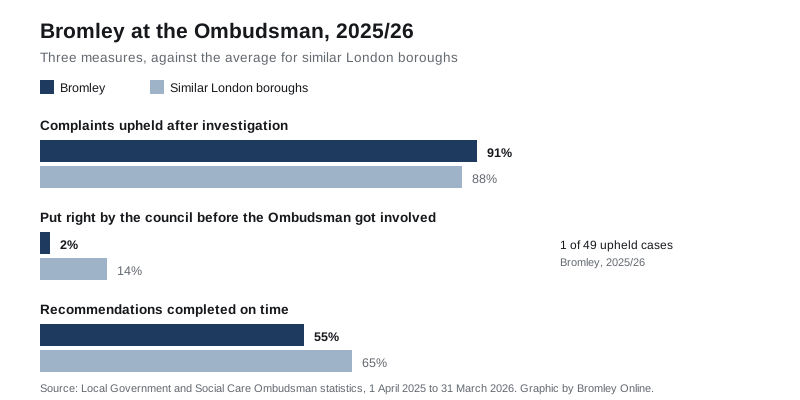
Once the Ombudsman does rule, the council does comply. All 49 recommendations were carried out. But only 27 of the 49 were completed within the agreed timescale, a 55% on-time rate against an average of 65%.
What it means for you
If you are stuck with the council over an EHC plan, a repair, a bin, a parking notice or a planning matter, the route is fixed and it is free.
- Complain to the council first. Bromley’s own procedure says it will respond within 20 working days. The Ombudsman will normally not look at anything until the council has had that chance.
- Keep the paperwork. In this case the council told the Ombudsman it could not find a complaint that the investigator was able to locate from the evidence supplied. Send complaints in writing, keep a copy, and note the date.
- Then go to the Ombudsman. It is free. Complain online at lgo.org.uk or call 0300 061 0614. The Ombudsman says it cannot normally look at a complaint once more than 12 months have passed since you first knew about the problem (how to complain).
- Some things go elsewhere. Two of the Bromley cases closed since June were turned away because a tribunal was the right route. Council tax liability goes to a valuation tribunal (decision 26 000 640), and the content of an EHC plan goes to the First-Tier Tribunal for Special Educational Needs and Disability (decision 25 021 517).
Our guides set out the rules the council is meant to be working to on the services people complain about most: bin collection days, parking in Bromley, council tax bands and planning applications.
Sources
- Local Government and Social Care Ombudsman, decision 24 023 431, London Borough of Bromley, upheld, 24 June 2026 (the 20 months, the £9,000, £2,160 and £500 payments, the missed annual review, the complaint handling finding)
- Ombudsman decision 25 006 737, London Borough of Bromley, upheld, 4 June 2026
- Ombudsman: London Borough of Bromley statistics, 1 April 2025 to 31 March 2026 (179 complaints, 54 investigated, 49 upheld, 91% upheld rate, 14.6 per 100,000, 2% satisfactory remedy, 100% compliance, 55% on time)
- Ombudsman decision search for the London Borough of Bromley, decisions published from 1 June 2026
Have your say