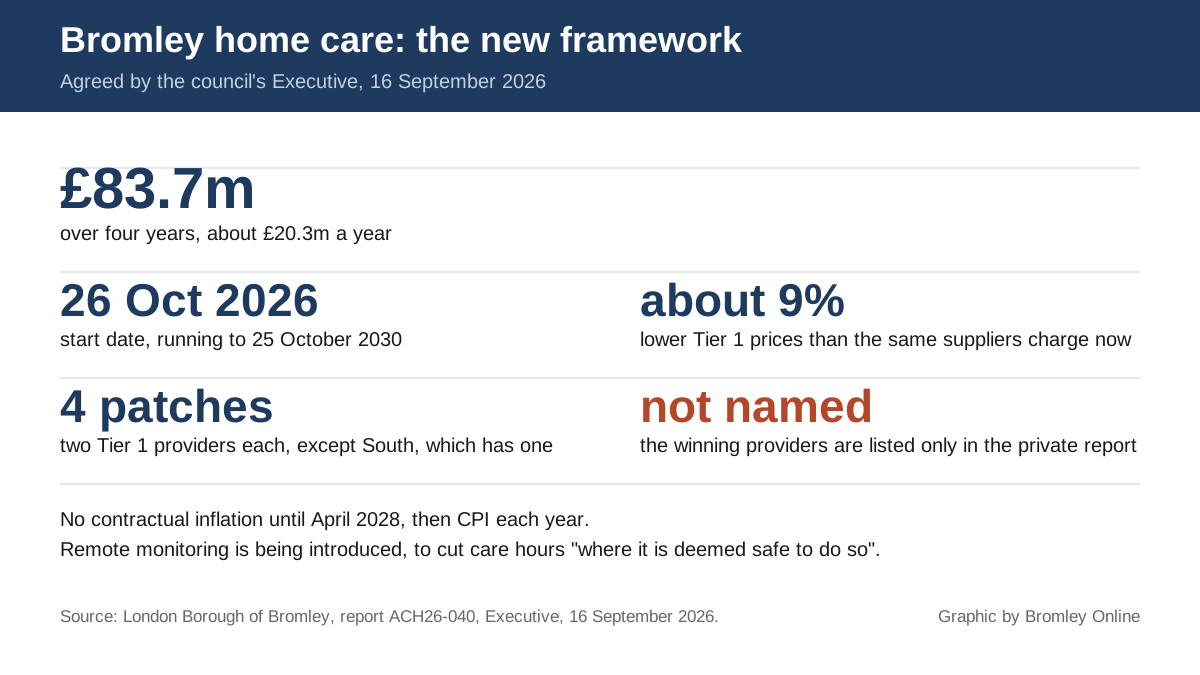

Bromley's home care changes hands on 26 October under an £83.7m four-year framework. Two providers per patch, prices down about 9%, and the names stay private.
Who comes to the door to help people wash, dress and eat at home in Bromley changes on 26 October. The Executive approved a new four-year domiciliary care framework on Wednesday 16 September, worth an estimated £20.3m a year and £83.67m over its life (report ACH26-040).
The council will not say publicly who won. The providers are named only in a Part 2 report that members read in private, so the public record of a contract worth £83.67m does not include the companies delivering it.
What actually changes
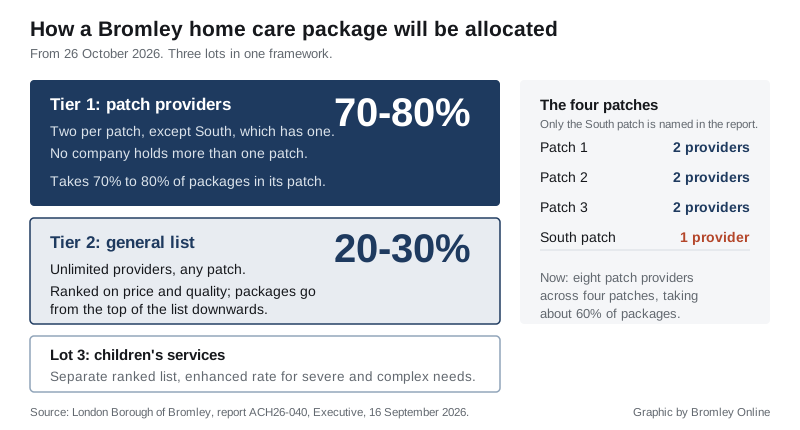
Bromley currently runs two separate frameworks: eight “patch” providers covering four areas of the borough, plus an open general framework. The patch providers take about 60% of care packages between them, and the report says that share is not spread evenly and “not all patches perform at 60%”.
From 26 October the two merge into one framework with two tiers.
- Tier 1 providers get a patch. Each of the four patches has two Tier 1 providers, except the South patch, which has one. No company gets more than one patch.
- Tier 1 providers take 70% to 80% of the work in their patch, up from the current 60% target.
- Tier 2 is an unlimited list, taking the remaining 20% to 30%, and can work in any patch.
- Tier 2 providers are ranked on price and quality after the tender, and packages are given out from the top of that list downwards.
- A separate third lot covers children’s services, with an enhanced rate for severe and complex needs.
Pricing moves to a “cap and collar”, a fixed maximum and minimum, which the report says gives the council budget stability and providers a floor to plan against. There is no contractual inflation until April 2028, after which prices rise by CPI each year.
The prices came in lower
The council says the tender produced a circa 9% reduction on current Tier 1 patch prices from the same suppliers, whether they are patch or general providers now. For children’s severe and complex care the indication is circa 8% lower.
The budget does not change: £18.8m in adult services and £1.5m in children’s services this year, £20.3m together. The £83.67m whole-life figure assumes CPI runs at the government’s 2% target, so it is a forecast, not a ceiling.
| Contract year | Estimated value |
|---|---|
| Year 1 | £20.3m |
| Year 2 | £20.7m |
| Year 3 | £21.1m |
| Year 4 | £21.5m |
| Total | £83.7m |
The monitoring, and what it is for
Buried in the background section is a change residents will feel. Commissioners will introduce Intelligent Lilli, a remote monitoring system, for adults assessed for home care either in the community or on discharge from hospital.
The report is direct about the purpose. It says this “will have the impact upon the Tier 1 and Tier 2 providers in reducing care packages where it is deemed safe to do so”, and describes the system as remotely monitoring “a resident’s activities for better and efficient care planning”.
The council is also extending its Trusted Assessor model for residents on low level packages, and all Tier 1 providers have to take part.
The gap the report does not explain
The old Tier 1 patch framework expired on 27 August 2026. The new one starts on 26 October 2026. That is roughly two months, and the report does not say what covers it. It describes the expiry only as an opportunity to combine the frameworks.
No interim arrangement is recorded in the Part 1 papers. If the council publishes one, we will add it here.
How the decision was made
The tender went live on 31 March 2026 and closed on 8 May. The evaluation panel drew staff from adults and children’s commissioning, adult social care, contract compliance and quality, finance and children’s social care. The Adult Care and Health scrutiny committee saw the report on 8 September, with children’s scrutiny members invited.
These are “light touch” public contracts under the Procurement Act 2023, which allows more flexibility than a standard above-threshold procurement. The duty to provide the care itself comes from the Care Act 2014 for adults, and the Children Act 1989 and Children and Families Act 2014 for children.
The Executive also gave the Director of Adult Social Care delegated authority to promote a provider from a reserve list into Tier 1 if an existing one drops out for any reason other than suspension. The report flags a financial risk in that: the replacement’s tendered price may be higher.
What it means for you
- If you or a relative already receive home care, your provider may change. The framework starts on 26 October. The council has not published which companies are on it, so ask your social worker or the adult social care team directly.
- Nothing here changes who is eligible. Eligibility still comes from a Care Act assessment, not from the contract.
- Expect to be offered monitoring. Intelligent Lilli is being introduced across the framework, and the council’s stated aim is to reduce hours where it judges that safe. Ask what it records and how a decision to cut hours would be reviewed.
- The decision can be called in. The report records call-in as applicable.
- To request an assessment, contact Bromley’s adult social care team through the council’s adult social care pages.
Home care is one part of a bigger shift. At the same meeting the Executive agreed to spend up to £7.2m on outside advisers to redesign learning disability care.
Sources
- London Borough of Bromley, Contract Award for the Domiciliary Care Framework, report ACH26-040, Executive, 16 September 2026
- London Borough of Bromley, Executive decision sheet, 16 September 2026
- London Borough of Bromley, Executive agenda, 16 September 2026
Have your say