
Bromley will spend up to £7.2m on outside advisers to redesign learning disability care, paid from reserves. Borrowing adds £4.3m to the bill.
Bromley Council will pay an outside firm to redesign the way it supports adults with learning disabilities, at an estimated cost of up to £7.2m taken from its reserves. The Executive agreed to start the tender on Wednesday 16 September, and the tender documents went out the next day. The report says Bromley adult social care transformation has been aimed mainly at older people for the last decade, and that working age adults are the next priority.
The work is called the Better Lives Programme. It runs in two parts (report ACH26-042):
- Phase 1 is a 12-week diagnostic study of what the council currently buys and what it costs, priced at £450,000 to £500,000.
- Phase 2 is three years of implementation support, priced in the report at £4.5m to £5.5m. It only happens if the Executive agrees again after seeing the Phase 1 findings.
Adding £350,000 a year of extra council staffing, the report puts the total at £7.2m.
Why the council says it has to act
Roughly half of everything Bromley spends on adult social care now goes on adults with a learning disability. In 2017/18 it was about 26%.
The council supports a smaller share of working age adults than the national average, 0.76% of the population against 0.88%, but at a higher cost. The report is blunt about where the money goes:
- 18.2% of those adults are supported in care homes, against 14% nationally
- those placements use 41% of the working age adults budget
- they cost about £100,000 each a year, against £78,000 nationally
- “a large majority of this residential care is out of borough”
Fewer young adults with learning disabilities in Bromley live independently than in England as a whole, 75.5% against 81.6%. The report names one driver: young people placed in residential schools by children’s services move across to adult services already in residential care.
The caseload is growing, and growing youngest. Bromley’s learning disability caseload rose from 699 in 2020 to 783 in 2023, up 12%. In the 18 to 24 age band it rose from 61 to 117, up 92%.
The part the headline figure does not cover
Because the money comes from reserves rather than revenue, the council treats it as “precipitated borrowing”. That carries interest and a Minimum Revenue Provision charge, and those land on the revenue budget every year.
The report’s own table puts that at £4.3m across six years: £70,000 in 2026/27, then £730,000, then £860,000 a year through to 2031/32.
Set against it, cumulative cashable savings are forecast to reach £7.0m by 2031/32. So the £7.2m of spending plus £4.3m of financing is measured against £7.0m of cash savings, with a further £2.4m of cost avoidance on top.
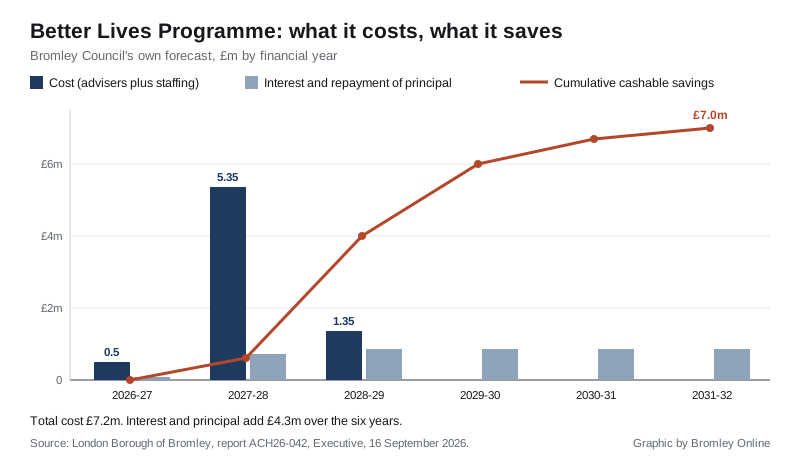
The saving stream also tapers while the borrowing charge does not. The report’s year by year table shows annual savings peaking at £4.626m in 2028/29, then falling to £900,000 and £350,000. The interest and principal charge stays at £860,000. By 2031/32 the report forecasts a net cost of £510,000 for the year.
Two further caveats sit in the report:
- The presentation of those figures depends on the council getting consent from the Secretary of State for capital flexibilities. The report says it “is subject to this approval”.
- If Phase 2 goes ahead with the adviser, part of their fee is contingent, meaning it is set against the savings actually agreed. The size of that arrangement is not fixed yet and will be settled during Phase 1.
What the council considered instead
Officers set out three options. Doing nothing was ruled out as unsustainable. Doing it with existing council staff was costed at nothing extra, but the report says the council “does not currently have the capacity or expertise to realise the full potential” and that change “will likely take longer to achieve”. Option 3, an open tender for an advisory partner, was recommended and agreed.
There is no legal duty to buy this advice. The report says the council is using the general power of competence under section 1 of the Localism Act 2011.
The decision came at the same meeting where the Executive noted a forecast overspend on services of £4.556m, three months into the financial year.
What happens next, and when
The procurement is an open tender under the Procurement Act 2023, scored 60% on price and 40% on quality, with a notice on the Find a Tender service. The report’s timetable is:
| Stage | Date |
|---|---|
| Tender documents issued | 17 September 2026 |
| Tenders returned | 8 October 2026 |
| Evaluation | 12 to 23 October 2026 |
| Award report to scrutiny | 23 November 2026 |
| Award report to the Executive | 25 November 2026 |
| Contract award | Late December 2026 |
| Contract start | January 2027 |
What it means for you
- Nothing changes in anyone’s care package yet. Phase 1 is a review of spending and provision, not a reassessment of individuals.
- The direction of travel is away from residential care. The stated aims include helping people in care homes move “to support into the community with or close to family where possible”, and more support for families looking after adult children at home. If that affects your family, the Phase 1 findings due before 25 November are the document to read.
- There is a second decision point. Phase 2, the £4.5m to £5.5m part, is not agreed. The Executive has to approve it separately after Phase 1.
- The decision can be called in. The report records call-in as applicable, so a scrutiny committee can ask the Executive to look again.
- Papers are public. Executive agendas and reports are published at cds.bromley.gov.uk. Meetings are held at the Civic Centre, Churchill Court, 2 Westmoreland Road, BR1 1AS.
The programme sits under the Bromley Learning Disabilities Strategy 2025 to 2030, agreed with the South East London Integrated Care Board and, the report says, co-produced with residents with a learning disability and their carers. That strategy is not published online; the report lists it as a background document available through the contact officer.
Bromley’s new Local Offer site for SEND and adult learning disability services is covered in our report on the new Bromley SEND website.
Sources
- London Borough of Bromley, Gateway 1: Proceeding to Procurement for Advisory Partner to the Better Lives Programme, report ACH26-042, Executive, 16 September 2026
- London Borough of Bromley, Executive decision sheet, 16 September 2026
- London Borough of Bromley, Executive agenda, 16 September 2026
Have your say