
Recorded knife crime in Bromley fell 13% in a year, but under-25 injury victims rose from 14 to 23. City Hall says London admissions are down 55%.
Recorded knife crime in Bromley fell by 13 per cent in the year to August, but more young people were hurt. Victims aged 24 and under injured by a knife rose from 14 to 23, according to our count of Metropolitan Police figures.
The borough’s numbers sit behind a bigger claim from City Hall. On 23 October the Mayor of London, Sadiq Khan, said his Violence Reduction Unit (VRU) would reach its one millionth Londoner during that month. He also said hospital admissions of young people for knife assault had fallen by 55 per cent since it was set up in 2019.
City Hall’s release does not mention Bromley, so we went to the data underneath it.
Bromley’s figures
These are our totals from the Met’s monthly crime data, for the same period City Hall used.
| Bromley borough, 12 months to August | 2025 | 2026 | Change |
|---|---|---|---|
| Knife crime offences | 316 | 276 | down 12.7% |
| Knife crime offences with injury | 67 | 67 | no change |
| Knife injury victims aged 24 and under | 14 | 23 | up 9 |
| Personal robbery offences | 421 | 414 | down 1.7% |
| Violence with injury offences | 1,820 | 1,814 | down 0.3% |
The fall in Bromley’s overall knife crime is sharper than London’s, which City Hall puts at 9.7 per cent. Offences where someone was injured did not fall at all. The rise in young victims comes from small numbers, so a few incidents can move it a long way.
The Met has since added September. That takes Bromley’s knife crime total for the 12 months to 271, against 308 a year earlier. Knife offences with injury stand at 69, against 61. Young victims are unchanged, at 23 against 14.
Four people, three of them boys aged 14 to 17, were stabbed on Bromley High Street on 10 September.
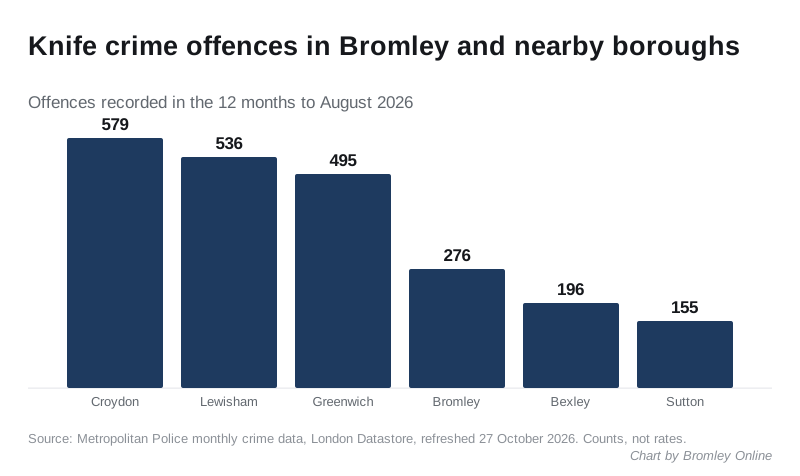
Bromley’s 276 offences were the 10th lowest of London’s 32 boroughs. Those are counts, not rates, so they do not allow for the size of each borough’s population. Among its neighbours, Croydon fell by 15.8 per cent to 579 and Lewisham by 9.6 per cent to 536. Bexley rose from 193 to 196 and Greenwich from 476 to 495. Sutton recorded 155.
Where Bromley differs from London
City Hall measures its progress against 2018/19, the year before the VRU began. On that test, Bromley matches London on one measure and goes the other way on another.
- Violence with injury: Bromley fell from 2,155 offences to 1,814, down 15.8 per cent. London fell by 15.9 per cent.
- Personal robbery: Bromley rose from 363 offences to 414, up 14 per cent. London fell by 28.7 per cent.
The Bromley figures compare 2018/19 with the 12 months to August 2026, using the Met’s 2018/19 file and the current one. The Met says a change to its crime classifications in October 2025 affected the groupings for violence against the person.
What City Hall is claiming
The headline number needs unpacking. The release says the VRU has reached one million “young Londoners”, but its breakdown is three-quarters of a million young people plus 250,000 parents, carers, youth workers and professionals who have had training or support. That covers just over seven years and more than £140m of investment.
City Hall’s analysis of violence in London sets out the London figures:
- Hospital admissions of under-25s after assault with a knife or sharp object: 260 in the 12 months to July 2026, down 55.6 per cent on 2018/19. The fall for England outside the Met’s area was 48 per cent.
- Violence with injury: 65,678 offences in the 12 months to August 2026, 12,429 fewer than in 2018/19.
- Gun crime: 1,725 offences, down 27.8 per cent on 2018/19.
- Personal robbery: 22,760 offences, down 28.7 per cent on 2018/19.
- Knife crime: 13,648 offences, down 9.7 per cent on the previous 12 months. The release also says there were 2,500 fewer victims of knife crime over the last three years.
The same analysis includes two details the release leaves out. Violence with injury rose by 1.3 per cent in the latest year, or 854 more offences, although City Hall says it remains well below 2023 levels. And knife crime cannot be compared with the years before the VRU, because the Met changed how it records the data from April 2024.
The NHS admissions figures are published by police force area, so there is no Bromley number. Those from April 2025 onwards are provisional.
What the VRU does, and the Bromley link
The release lists the unit’s work:
- hospital-based youth workers, who City Hall says have guided 75 per cent of young people away from further harm
- youth workers in police custody suites, who have connected with nearly 17,000 young people
- MyEnds, its neighbourhood programme, which City Hall says has provided 60,000 targeted interventions
- London’s Inclusion Charter, which City Hall says has driven down suspensions, exclusions and absenteeism in its first full year
City Hall says school exclusion doubles a young person’s risk of being involved in violence within 12 months.
The release gives no figure for how many of the one million live in Bromley. City Hall points to a VRU dashboard for the breakdown of who has been reached, which we could not extract figures from.
The older records we could find show two links. A City Hall decision paper from November 2022 listed Bromley, with Croydon and Sutton, among the boroughs receiving ENGAGE, which works with 10 to 17 year olds in police custody. In 2019, Bromley Council’s portfolio holder told councillors the borough would get £50,000 a year for two years from a £14m VRU fund, and called that “a rather small allocation”. We could not find a current figure for what Bromley receives.
What they said
The Mayor and Lib Peck were due to visit a VRU programme at a south London club on the day of the announcement. The release does not name the club.
Sadiq Khan said: “I set up the Violence Reduction Unit just over seven years ago because of a clear and long-held view that we cannot arrest our way out of violence. Violent crime is preventable, not inevitable.”
He added: “As we hit the milestone of reaching one million young people through the VRU, we are able to demonstrate that a public health approach to tackling violence and exploitation works. Hospital admissions of young people for knife assault are down by more than half, and there are thousands of fewer victims of violence and gun crime, but I’m clear there is more to do to reduce violence and exploitation.”
The release blames national cuts to youth services between 2010 and 2019 for the rise in violence that followed. The Government already provides some funding for the VRU, and the Mayor wants ministers to commit to consistent, multi-year funding. He said: “We are turning the tide in our efforts to tackle violence and look forward to working with the Government in order to realise our shared national ambition of halving knife crime, supported by a long-term, multi-year financial backing that our communities deserve.”
Lib Peck, the VRU’s director, said: “Our prevention and early intervention approach is built around catching young people at points of crisis or vulnerability and giving them the support they need towards safety and opportunity.”
She added: “History shows what happens when you cut the very services working to prevent violence and so it’s crucial that we keep the momentum up so that every young person in London is safe and supported to thrive.”
Martin Griffiths, a consultant trauma surgeon at Barts Health NHS Trust and Clinical Director of the Violence Reduction Network for the NHS in London, said: “A 55 per cent fall in young people admitted to hospital for knife assault is welcome news. Every one of those injuries is a tragedy however, but behind this fall are young Londoners who are safer and families spared the worst day of their lives.”
He said: “There is more to do, and the NHS is committed to walking alongside the VRU to keep young Londoners safe.”
What it means for you
London’s trend is real in the data, and Bromley’s total knife crime is moving the same way. It does not yet show up as fewer knife injuries here. Offences with injury are flat, and more young people were among the victims.
City Hall’s figures also cannot tell you what the VRU has achieved in Bromley. They do not separate out the borough, and crime falling after a programme starts does not by itself show the programme caused it. City Hall credits both enforcement and the VRU’s work.
The Met updates its borough figures each month, so anyone can check these numbers as they change.
Have your say