
St Olave's put 91.5% of grades at 9 to 7 and Bromley High 74%. Seven Bromley schools published figures, the council none, and here is how to read them.
Year 11 across Bromley collected GCSE results on Thursday 20 August. Seven schools in the borough have since published figures on their own websites. The council has published none.
St Olave’s Grammar School in Orpington reported the highest: 91.5% of its grades at 9 to 7, and 53% at grade 9 alone. Eleven of its pupils were awarded a grade 9 in every subject they sat.
That is a selective school, and it should not be read against a comprehensive down the road. The more useful comparison sits lower down this page, on the one measure four Bromley schools happened to publish in the same form.
What each school published
- St Olave’s Grammar School, Goddington Lane, Orpington: 91.5% of grades at 9 to 7, 79% at 9 or 8, 53% at grade 9. Headteacher Andrew Rees said the results “reflect not only their talent, but also the hard work, determination and resilience they have shown”.
- Bromley High School, Blackbrook Lane, Bromley: 28% of grades at 9, 52% at 9 to 8, 74% at 9 to 7 and 98% at 9 to 4. The school is independent and publishes a full table, subject by subject.
- Ravens Wood School, Oakley Road, Bromley: 77% of students got grade 4 or above in both English and maths, and 55% got grade 5 or above in both, up from 46% last year. It awarded 432 grades at 7 to 9.
- Darrick Wood School, Lovibonds Avenue, Orpington: 76% at grade 4 or above in both English and maths, 51% at grade 5 or above in both, and 23% of all its GCSEs at 7, 8 or 9.
- Bullers Wood School for Boys, Chislehurst Road, Bromley: 73% at grade 4 or above in English and maths, 46% at grade 5 or above in both, and 15.6% of grades at 7 or above.
- Langley Park School for Girls, Hawksbrook Lane, Beckenham: 35% of grades at 7 to 9, and 68% of students at grade 5 or above in both English and maths. Half the year group secured a strong pass in the English Baccalaureate.
- Orion Eden Park, Beckenham: almost 25% of grades at 7 to 9, and almost 15% at grade 8 or 9. In English 30% of grades were at 7 to 9, in maths 27%.
Orion Coopers in Chislehurst said its Year 11 had recorded the best GCSE results in the school’s history, and that a record number reached grade 5 or above in both English and maths. It did not publish a percentage, so there is nothing to compare.
The council’s own directory lists 19 state secondary schools in the borough. Several of the best known had put up no 2026 figures when this was written. Newstead Wood School still shows its 2024 and 2025 GCSE results, and Bullers Wood School for girls its 2023 to 2025 data.
The one measure four schools shared
Four of the seven published the same thing: the share of pupils reaching a given grade in both English and maths. That is a per-pupil measure, and it is the one the Department for Education publishes for every council area, so for once a school figure and a borough figure sit on the same basis.
Bromley’s own record on it has slipped for two years running.
| Year | Bromley, grade 4+ | Bromley, grade 5+ | London, grade 5+ | England, grade 5+ |
|---|---|---|---|---|
| 2022/23 | 73.2% | 55.2% | 54.1% | 45.3% |
| 2023/24 | 73.0% | 55.7% | 55.1% | 45.9% |
| 2024/25 | 72.0% | 53.5% | 52.9% | 45.4% |
Source: DfE Key stage 4 performance, all state-funded pupils, via the department’s statistics API.
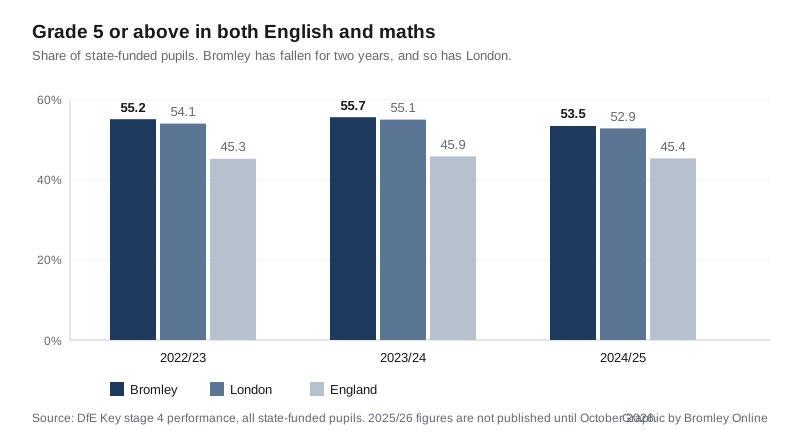
Bromley remains ahead of London and well ahead of England. It is also 1.2 points lower on the 4+ measure than it was two years earlier, and 2.2 points lower on the 5+ measure. Read against that, Ravens Wood’s 55% and Darrick Wood’s 51% sit close to the borough, and Langley Park Girls’ 68% sits a long way above it.
One caution. Those borough, London and England figures are for the 2024/25 academic year, published in April 2026. This summer’s national and local figures do not exist yet. The next edition of the DfE data is due in October 2026, so nobody, including the council, can honestly compare a 2026 school result with a 2026 national one on this measure today.
How to compare a school fairly
Ofqual published its summer 2026 statistics at 9.30am on results day. They count individual results, not pupils, across 5,720,045 GCSE results in England.
There is no single national average. There are four, and they say different things:
| Benchmark | Grade 7+ | Grade 4+ |
|---|---|---|
| England, all ages | 21.8% | 67.0% |
| England, 16-year-olds | 23.1% | 70.7% |
| London, all ages | 28.6% | 71.7% |
| London, 16-year-olds | 30.2% | 75.5% |
Source: Ofqual tables 19a and 19b. The all-ages rows include resits, mostly taken at colleges by students who did not reach grade 4 first time. A school’s Year 11 has almost none of those, which is why the 16-year-old rows sit three to four points higher.
For a London school the fair line is the London 16-year-old one: 75.5% at grade 4 or above, 30.2% at grade 7 or above.
The type of school matters more still. Ofqual’s table 20 puts England’s grammar schools on 97.4% at grade 4 or above and 63.2% at grade 7 or above. Independent schools are on 88.4% and 47.1%. Academies are on 68.2% and 19.7%, and council-maintained comprehensives on 68.6% and 20.1%.
Sixth form colleges come out at 32.2% and further education establishments at 17.6%. Those two are resit centres. The table is not a league table of teaching quality, it is a map of who sits which exams where.
So St Olave’s 91.5% at 9 to 7 is best read against the grammar figure of 63.2%, where it is far ahead. Bromley High’s 74% belongs next to the independent 47.1%. Comparing either with a comprehensive tells you about admissions, not about schools.
There is one figure nobody can check. Ofqual’s tables report grade 7 and above, and grade 4 and above, and nothing else. There is no official England percentage for grade 9, and none for grades 9 to 5. If you see a school or a council quoting a national grade 9 average, it did not come from the official statistics.
What it means for you
If a grade looks wrong, there are two routes and both close on Thursday 24 September 2026, according to JCQ:
- a clerical re-check, which confirms the marks were added and recorded correctly, returned within 10 calendar days
- a review of marking, which puts the paper in front of a senior examiner, returned within 20 calendar days
Three things families get wrong every August:
- The priority service does not apply to GCSEs. The 20 August priority deadline covered AS, A level and Level 3 vocational qualifications only, because those decide university places.
- You cannot apply yourself. The request goes through the school’s exams officer, and the school needs the student’s written consent first.
- There is no grade protection. A review can move a grade down as well as up, and JCQ requires candidates to be told so before they consent.
Orion Eden Park has told its students it will cover the cost of a review of marking for anyone close to the next boundary in one of their best eight GCSEs. That offer is specific to that school, so ask your own before assuming.
Anyone who did not reach grade 4 in English or maths sits them again in November, and the papers are already timetabled. On the Pearson Edexcel timetable, all in the morning:
- English Language paper 1: Tuesday 3 November
- Maths paper 1: Wednesday 4 November
- English Language paper 2: Thursday 5 November
- Maths paper 2: Friday 6 November
- Maths paper 3: Monday 9 November
Entries go through the school or college, not the family, so the conversation to have this week is with the exams officer.
Sixth form places are usually conditional on grades, and most borough schools enrol in the days straight after results. If the grades came in under the offer, ring the school before term starts rather than waiting for September.
Have your say